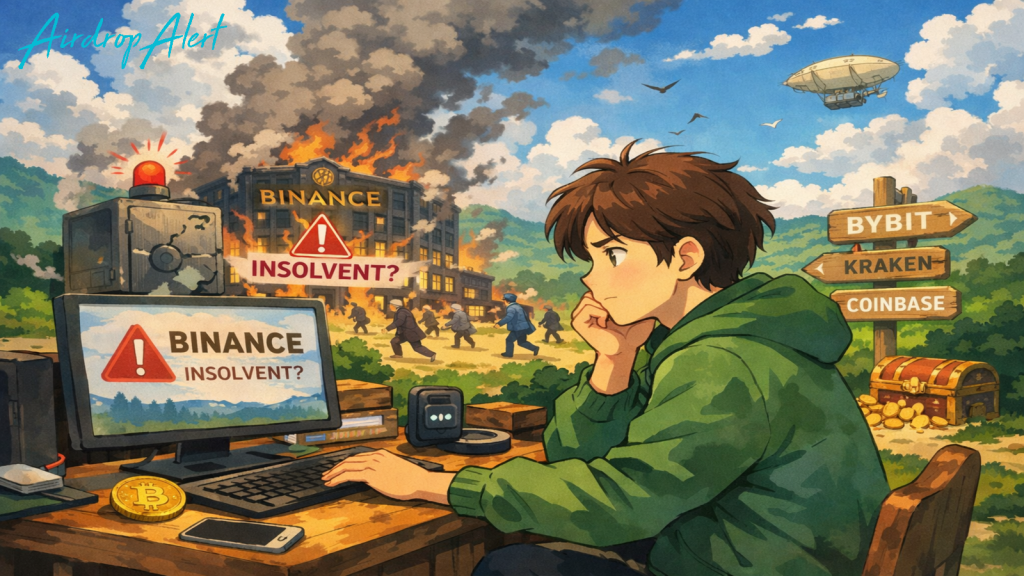
While Bitcoin has been bleeding toward the $69k level — the previous 2021 all-time high — crypto Twitter has been doing what it does best. Losing its mind.
Rumors have been flying nonstop, but one story stands out more than the rest.
The possible insolvency of an industry giant.
Drumroll…
Binance.
Yes, you read that right.
After fresh allegations that Binance played a role in the October crash, a new wave of voices now claims the exchange itself could be insolvent. CZ is pushing back hard. The company denies everything. But users are nervous.
So what is actually happening?
And if you still use Binance, are your funds at risk?
Today, we take a closer look.
I’ve Seen This Movie Before
I survived the Mt. Gox disaster.
I sidestepped the FTX collapse.
In between those events, I watched dozens of exchanges get hacked, go bankrupt, or simply disappear overnight.
Here’s the interesting part.
I never had funds stuck on any of them when they went down.
Am I the luckiest crypto guy alive?
Or have I just learned when to step aside before things get ugly?
In crypto, survival matters more than loyalty.

Where Did the “Binance Insolvent” Rumor Come From?
The current wave of FUD started on X, where a user claimed Binance was insolvent and warned of a “catastrophic” market impact. Shortly after, screenshots of an alleged cease-and-desist letter began circulating.
According to Binance, the letter was fake.
The exchange publicly stated the document did not come from them and called it a forgery. No legal action was taken, and no posts were officially requested to be removed.
Still, once a rumor like this starts, it rarely stops there.
Withdrawal Campaigns and Growing Tension
Even though Binance denied the claims, the damage was already done.
Some users initiated withdrawal campaigns, urging others to pull funds as a “stress test.”
Fear spreads faster than facts in crypto.
Interestingly, Binance stated that total assets held on the platform actually increased after withdrawals began. On-chain data providers also reported no panic-level outflows similar to what we saw during FTX.
That said, rumors don’t need to be true to cause real consequences.
They only need to be believable.
What the Data Actually Shows
If you want to look beyond emotions, data helps.
Using DeFiLlama’s CEX dashboard, you can track centralized exchange balances in real time.

From Q4 until now, Binance’s total reported assets dropped from roughly $210B to around $148B. That is a sharp decline, even accounting for market drawdowns and asset price changes.
Recent netflows appear slightly positive again, but the trend is worth monitoring closely.
When withdrawals pause — even briefly — fear accelerates.
We’ve seen this pattern before.
Binance’s Defense: Proof of Reserves and SAFU
Binance continues to publish proof-of-reserves data, showing assets exceeding user balances.
The exchange also moved additional Bitcoin into its SAFU insurance fund, converting stablecoins into BTC. According to Binance, this is part of a longer-term strategy, not an emergency move.
On paper, nothing screams immediate insolvency.
But crypto history has taught us one thing.
Problems rarely announce themselves loudly at the start.
“Where There’s Smoke, There’s Fire”
Here’s my personal rule.
If there’s smoke, I don’t wait to see flames.
Why risk getting burned?
Crypto gives us unlimited options. No exchange deserves blind trust, especially not during periods of heavy FUD.
If I had funds on Binance today — which I don’t — I would withdraw them.
Not because I’m convinced Binance is insolvent.
But because the downside risk is asymmetric.
Learn what smart farmers are doing right.
What I Would Do Instead
If you’re not actively trading, self-custody is still king.
Hardware wallets exist for a reason.
If you are trading this dip and need a centralized exchange, there are plenty of alternatives that don’t currently sit in the middle of this storm.
A few options traders commonly rotate to:
This isn’t about picking sides.
It’s about staying liquid and alive.
Why “Standing Behind Binance” Makes No Sense
Some users argue that withdrawing funds helps spread FUD.
That mindset is dangerous.
There is zero benefit in risking your capital out of principle.
If the rumors are fake, you can redeposit later.
Business as usual.
If the rumors are real, you could lose everything in seconds.
Crypto rewards caution, not loyalty.
Support Our Work
If you found this helpful, consider signing up on BloFin (Non-KYC) or Bybit using our referral links. Your support keeps this content free and flowing.
Final Words
The question isn’t whether Binance is insolvent today.
The real question is why you would gamble your funds when uncertainty is this high.
Crypto has always been survival of the fittest.
That rule hasn’t changed.
Stay flexible.
Stay skeptical.
And most importantly, stay in control of your own money.
If this turns out to be nothing, great.
If it turns into something bigger, you’ll be glad you moved early.
In this market, that’s not fear.
That’s experience.
I’m risking a cease and desist from Binance by bringing you this update. I hope you do something with it.
If you enjoyed this blog, be sure to check out our latest on crypto buzzwords.
As always, don’t forget to claim your bonus below on Bybit. See you next time!